-
×
 Brie De Meaux 180g
1 × €7.20
Brie De Meaux 180g
1 × €7.20
 Brie De Meaux 180g
 Subtotal: €7.20

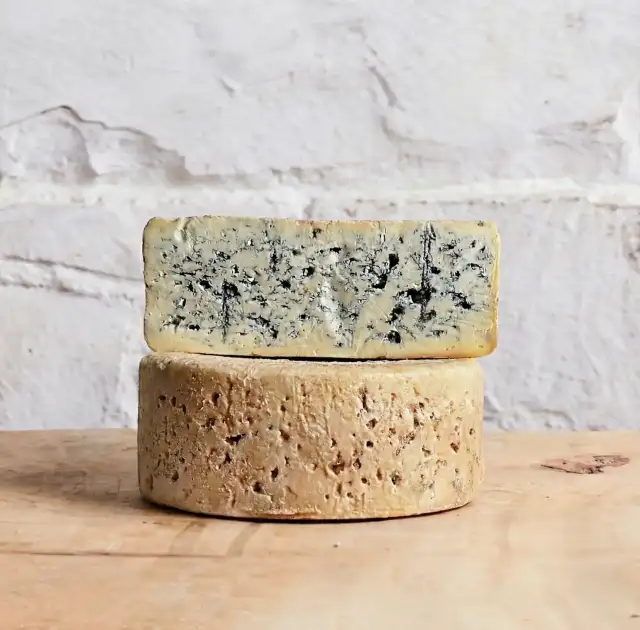
Bleu d’Auvergne has a semi-soft paste with a reasonably sharp blue flavour that contrasts beautifully with its creamy texture. The paste melts wonderfully in the mouth leaving an impression of smoothness and a slightly longer blue finish. Good Bleu d’Auvergne is perfectly balanced between fruity-sweet flavours and white pepper spiciness from the blue penicillium mould.
TypeBlue, Semi-firm
Rennettraditional
RegionFrance
ProducerAffineur Morins
Milkcow
Rindnatural
Price range: €6.60 through €19.80
Bleu d’Auvergne is a blue-veined cow’s milk cheese from Central and Southern France. Perhaps uniquely amongst the French AOC cheeses, the development of Bleu d’Auvergne may be traced back to a single individual, Monsieur Antoine Roussel. Roussel was a cheesemaker from the small town of Laqueille, west of Clermont-Ferrand. Upon his father’s death Antoine, as the eldest son, was forced to take over the day-to-day running of the family farm. The Roussels made a simple fourme-type cheese, the sale of which supplemented the meagre income they derived from farming. One day Antoine noticed that some of the cheeses had developed a natural blue veining. He was struck by how dramatically the blue mould improved the flavour of his product and decided that he would endeavour to encourage the growth of the mould in his cheese. After much fruitless experimentation with various aspects of production, he noticed that the rye loaves he kept near his cheeses were also turning blue. He hit upon the idea of using the mould on the rye loaves as a means of getting the blue moulds from the atmosphere into his cheese. By 1854 Roussel had a run-away success on his hands. As demand increased the price of Roussel’s cheese soared, and the family simply couldn’t produce enough. Neighbors were quick to get in on the act and production soon spread throughout the region. Roussel’s cheese received the ultimate accolade in 1973 when Bleu d’Auvergne was awarded the AOC
Jean-Pierre Morin studied cheese making at the Nation School of Dairy before settling in Cantal in the late 1960s. They began selling their cheeses in local village markets until they opened their own retail shop. The Morin’s cheese caves and affineur techniques produce a unique cheese with a definite sense of place and producer.
Cheese should be unpacked and stored in a cool place, ideally around 5 degrees. Take out about an hour before serving, and allow to come to room temperature. Leaving cheese come up to room temperature (“to chambre”) allows it to develop a fuller, more aromatic flavour. Beware temperatures that are too warm (hot kitchen) and try and let the cheese come up to temperature in a relatively cool place like a cool pantry. Harder cheeses can need a little more time than softer ones.
Cheeses like cheddars that have more open texture pastes where the curd is not heavily compacted during the cheesemaking process can have occasional blue veining. Though this blueing is caused by unintentional rouge pencillium genus mould that has found its way into the cheese, it is often sought after for its contributing flavour.
Frequently, cheeses that start to grow mould while aging, in storage, or during transit can be salvaged and are safe to consume. In the case of blue/white mould that has begun to form, it can be scraped off with regular dinner knife or back of chef knife, and bloomy rind cheeses often begin to re-rind themselves on the cut surface which can just be cut off or eaten.
Spoiled cheese has some key indicators – if you get an ammonia/sour smell or taste then it goes in the bin.
Fresh, high moisture, young cheeses (think mozzarella/ricotta/mascarpone/cream cheese) that have mould growing should be discarded immediately.
Moulds that show up with black or reddish hue should be discarded.
Our primary aim is to provide delicious, quality, safe cheeses to our Sheridans customers however cheese is a living thing with an agenda of its own. If you believe your cheese (or other food item) has spoiled, please contact us immediate at online@sheridanscheesemongers.com for a replacement or refund.
Allergens listed in BOLD
Ingredients: MILK, salt, lactic starters (MILK), animal rennet, Penicilium roqueforti
Nutritional values per 100g
Energy 1450kj / 350kcal
Fat 30 g
of which saturated 21,3 g
Carbohydrates (g) 0g
of which sugar (g) 0g
Proteins : 20 g
Salt 2.8g