
-
×
 Stockans Thin Oatcakes 100g
1 × €1.40
Stockans Thin Oatcakes 100g
1 × €1.40
 Stockans Thin Oatcakes 100g
 Subtotal: €1.40

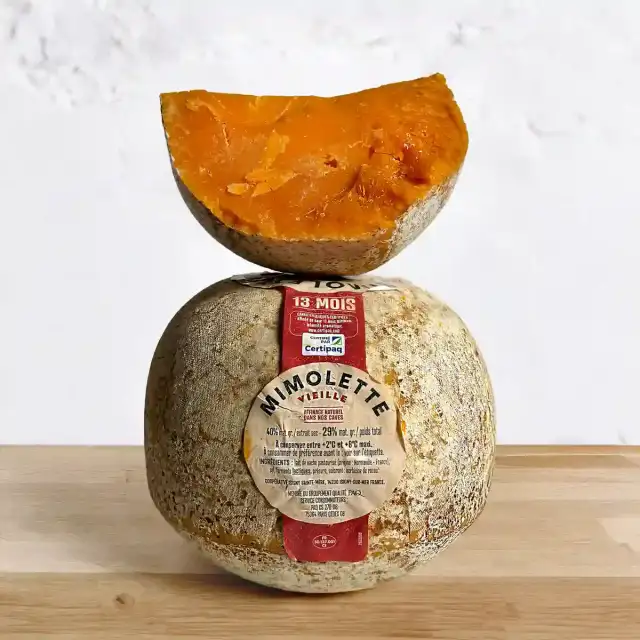



Mimolette is fruity cheese with earthy, hazelnut notes that deepen with age. The cheese is iconic for its small round shape, vibrant orange paste and craggy rind texture.
TypeHard
Rennettraditional
RegionFlanders, France
ProducerCesar Losfeld
Milkcow
RindN/A
€4.60
Mimolette is a hard, natural rind cow’s cheese from Flanders in Northern France. It derives its name from the French mi-mou mi-mol, meaning half soft, half hard. Mimolette is also known as Boule de Lille, after the town of Lille in Northern France, where many of the affineurs of this cheese, including the celebrated Cesar Losfeld, are based. Here in their dark cavernous cellars Losfeld allow the mites to slowly eat into the rind of the cheese; over a year the rind becomes poked as
the mites bore down into the hard paste. The resulting cheese resembles an ancient cannonball recovered from the floor of the ocean. The action of the mites is said to be responsible for an additional fruitiness in the flavour.
Mimolette traces its origins to the seventeenth century, when Colbert, the French contrôleur general, placed an embargo on foreign goods coming into France. The people of Flanders, deprived of a style of cheese for which they had acquired quite a fondness, responded by making this Dutch-type cheese for themselves.
César Losfeld's is home to more than 100,000 cheeses in its 3,000 m2 century-old cellars. Each cheese is matured on raw wooden boards within the thick walls of the caves. Once the round cheese wheels are formed, the rounds are seeded to allow the mites to colonize the cheese rinds. Then the cheeses are turned over at the start of ripening, mainly to prevent the young cheeses from collapsing and to ventilate and dry the side which rests on the board. The cheeses are brushed by hand regularly and as the cheese ages, the more it needs to be brushed as the mites are more active in an environment which they have already colonized. The brushing helps regulate the mites within the craters they have dug and allows the poles of the cheese to be dried. Once the cheese has aged and the rind has been sufficiently developed with the help of the mites, cheeses will be assessed by half-aged, aged, and extra-aged mimolettes. A selection thereof is then organized by the cellar master to determine which will be ready and those which still have to wait to reveal all their flavours. (adapted from losfeld site)
Cheese should be unpacked and stored in a cool place, ideally around 5 degrees. Take out about an hour before serving, and allow to come to room temperature. Leaving cheese come up to room temperature (“to chambre”) allows it to develop a fuller, more aromatic flavour. Beware temperatures that are too warm (hot kitchen) and try and let the cheese come up to temperature in a relatively cool place like a cool pantry. Harder cheeses can need a little more time than softer ones.
Cheeses like cheddars that have more open texture pastes where the curd is not heavily compacted during the cheesemaking process can have occasional blue veining. Though this blueing is caused by unintentional rouge pencillium genus mould that has found its way into the cheese, it is often sought after for its contributing flavour.
Frequently, cheeses that start to grow mould while aging, in storage, or during transit can be salvaged and are safe to consume. In the case of blue/white mould that has begun to form, it can be scraped off with regular dinner knife or back of chef knife, and bloomy rind cheeses often begin to re-rind themselves on the cut surface which can just be cut off or eaten.
Spoiled cheese has some key indicators – if you get an ammonia/sour smell or taste then it goes in the bin.
Fresh, high moisture, young cheeses (think mozzarella/ricotta/mascarpone/cream cheese) that have mould growing should be discarded immediately.
Moulds that show up with black or reddish hue should be discarded.
Our primary aim is to provide delicious, quality, safe cheeses to our Sheridans customers however cheese is a living thing with an agenda of its own. If you believe your cheese (or other food item) has spoiled, please contact us immediate at online@sheridanscheesemongers.com for a replacement or refund.
Ingredients: Pasteurized cow’s milk, cheese cultures, salt, enzymes, annatto, lysozyme (EGG)
For allergens see ingredients in bold
Nutritional values per 100g
Energy: 1673kJ/ 402Kcal
Fat: 29.3g
of which saturates: 19.3g
Carbohydrates: 1.9g
of which sugars: 1.9g
Protein: 32g
Salt: 3.1g


