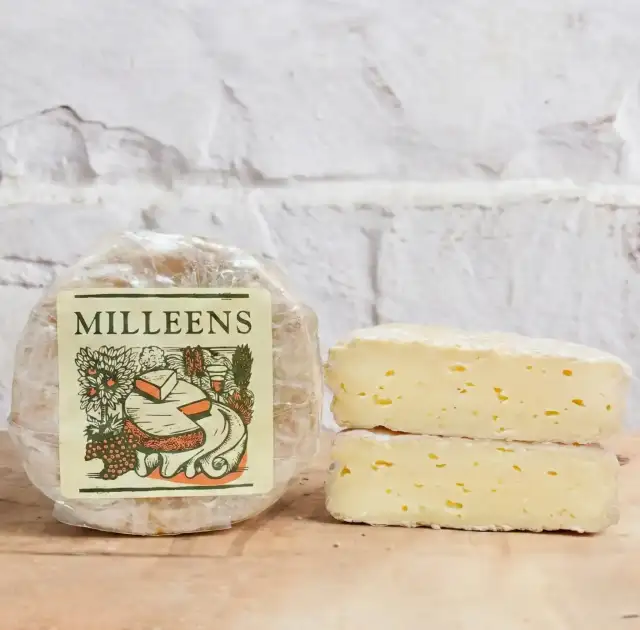

Milleens Dotes 200g
About This Cheese
Earthy, buttery, mushroom flavours are found in semi soft paste encased in a bold, pungent rind. This is one of the four classic Irish washed rind cheeses coming from Cork. Enjoy with crusty bread and a class of rustic Rhone red
TypeSoft
Rennettraditional
RegionBeara Peninsula, co Cork
ProducerMilleens
Milkcow
Rindwashed
€7.00

Story
Milleens is a washed rind cheese made with pasteurised cow’s milk. It is probably the strongest of the four classic Irish washed rinds, the others being: Durrus, Gubbeen. In ideal condition, Milleens should have an ever so slightly wet rind and a chalk paste which bulges towards the rind but remains chalky in the middle. The pleasure involved in eating good Milleens centres around the contrast between the whiffy, pungent rind and the fresh, lactic taste of the paste within. The paste, particularly of the small dotes, can be bulging, almost spilling, or it can be a little chalky yet moist. The flavour of the less attractive chalky cheeses can be surprisingly complex and satisfying, while the softer cheeses tend to be sweet and pungent. Certainly best enjoyed at room temperature.
Producer
Veronica and Norman Steele began making cheese on their farm at Milleens on the Beara Peninsula, Co. Cork, in 1976. It is generally seen as the first of the modern Irish farmhouse cheeses. Their son, Quinlan, has taken over cheesemaking and the milk is bought in from a neighbour, as the Steeles no longer keep their own herd. Depending on the season, the weather, which of the three variations of Milleens you are eating and, perhaps, the humour of the cheesemaker, this cheese can vary quite a bit but that’s what we like about it.
Goes Well With


You may also like…
FAQs
Cheese should be unpacked and stored in a cool place, ideally around 5 degrees. Take out about an hour before serving, and allow to come to room temperature. Leaving cheese come up to room temperature (“to chambre”) allows it to develop a fuller, more aromatic flavour. Beware temperatures that are too warm (hot kitchen) and try and let the cheese come up to temperature in a relatively cool place like a cool pantry. Harder cheeses can need a little more time than softer ones.
Cheeses like cheddars that have more open texture pastes where the curd is not heavily compacted during the cheesemaking process can have occasional blue veining. Though this blueing is caused by unintentional rouge pencillium genus mould that has found its way into the cheese, it is often sought after for its contributing flavour.
Frequently, cheeses that start to grow mould while aging, in storage, or during transit can be salvaged and are safe to consume. In the case of blue/white mould that has begun to form, it can be scraped off with regular dinner knife or back of chef knife, and bloomy rind cheeses often begin to re-rind themselves on the cut surface which can just be cut off or eaten.
Spoiled cheese has some key indicators – if you get an ammonia/sour smell or taste then it goes in the bin.
Fresh, high moisture, young cheeses (think mozzarella/ricotta/mascarpone/cream cheese) that have mould growing should be discarded immediately.
Moulds that show up with black or reddish hue should be discarded.
Our primary aim is to provide delicious, quality, safe cheeses to our Sheridans customers however cheese is a living thing with an agenda of its own. If you believe your cheese (or other food item) has spoiled, please contact us immediate at online@sheridanscheesemongers.com for a replacement or refund.
Nutritional Information
Ingredients: Pasteurised cow’s milk , starter cultures ,animal rennet, Salt.
For allergens see ingredients in bold
Nutritional values per 100g
Energy: 336Kcal/1415 kJ
Fat: 25 g
of which saturates: 17 g
Carbohydrates: 0g
of which sugars: 0g
Protein: 22 g
Salt: 2g