Brie De Meaux 180g
About This Cheese
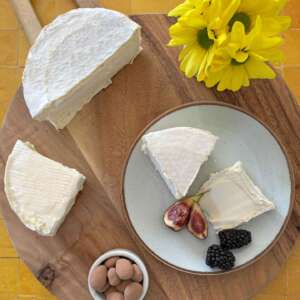
A full flavoured traditional brie with a mottled white rind. Expect earthy notes of cauliflower, mushroom, and cultured cream. Known as ‘The King of Cheeses’ Brie de Meaux is the best known soft cheese in France.
TypeSoft
Rennettraditional
RegionFrance
Producerdonge
Milkcow
Rindbloomy, white mould
€7.20

Story
The soft mould rind cheese is made with raw cow’s milk and takes its name from the area of Meaux some 50km from Paris. Brie has become a word, much like Camembert and Cheddar, to describe a style of cheese that can vary hugely in quality. There are some very good fermier (made by the farmer) bries made in France with raw milk. These tend to have a different, more pungent flavour. Great Brie de Meaux is full of flavour and aroma but is very balanced and restrained. It is made in a large, cylindrical disk approximately 35–40cm across and 5cm high. This gives the cheese a high surface area, which it needs if the bloom on the exterior is to break down the interior curd. It is this process that transforms the texture of the paste from chalky to supple. The candidum rind gives off a typical raw mushroom aroma and, when ripe, there is a slight sharpness. The flavour is steamed salty vegetables and cream.
Most bloomy-rind cheeses are shaped as flat disks allowing the rind work its way to the middle more quickly. If the cheeses were any thicker, it would take too long for this to happen, by which time the cheese closest to the rind would have matured past its best and be quite unpleasant.
Producer
Brie de Meaux is the quintessential Brie and we think Dongé are the best producers. Founded in the 1930s, the Dongé family name has become synonymous with craftsmanship and quality in the making of AOP/PDO Brie de Meaux. Each individual wheel of cheese is hand ladled, moulded, turned and ripened for 5 to 8 weeks.
Goes Well With





FAQs
Cheese should be unpacked and stored in a cool place, ideally around 5 degrees. Take out about an hour before serving, and allow to come to room temperature. Leaving cheese come up to room temperature (“to chambre”) allows it to develop a fuller, more aromatic flavour. Beware temperatures that are too warm (hot kitchen) and try and let the cheese come up to temperature in a relatively cool place like a cool pantry. Harder cheeses can need a little more time than softer ones.
Cheeses like cheddars that have more open texture pastes where the curd is not heavily compacted during the cheesemaking process can have occasional blue veining. Though this blueing is caused by unintentional rouge pencillium genus mould that has found its way into the cheese, it is often sought after for its contributing flavour.
Frequently, cheeses that start to grow mould while aging, in storage, or during transit can be salvaged and are safe to consume. In the case of blue/white mould that has begun to form, it can be scraped off with regular dinner knife or back of chef knife, and bloomy rind cheeses often begin to re-rind themselves on the cut surface which can just be cut off or eaten.
Spoiled cheese has some key indicators – if you get an ammonia/sour smell or taste then it goes in the bin.
Fresh, high moisture, young cheeses (think mozzarella/ricotta/mascarpone/cream cheese) that have mould growing should be discarded immediately.
Moulds that show up with black or reddish hue should be discarded.
Our primary aim is to provide delicious, quality, safe cheeses to our Sheridans customers however cheese is a living thing with an agenda of its own. If you believe your cheese (or other food item) has spoiled, please contact us immediate at online@sheridanscheesemongers.com for a replacement or refund.
Nutritional Information
Ingredients: raw Cow’s (MILK), salt, starter cultures, rennet
For allergens see ingredients in bold
Nutritional Info Per 100g
Energy kJ/kCal 1607/388
Fat 33g
of which saturates 20.8g
Carbohydrates 1.5g
of which sugars .1g
Protein 21.2g
Salt 1.4g